

2025-05-30
Seamless Steel Pipe: Your Comprehensive Guide to Manufacturing, Sizes, and More
Seamless Steel Pipe: Your Comprehensive Guide to Manufacturing, Sizes, and More
Seamless steel pipes are a critical component in numerous industries, known for their durability and high performance. But what is seamless steel pipe exactly, and what goes into its production? This guide will provide a detailed overview, from raw materials to delivery methods.
What is Seamless Steel Pipe?
Seamless steel pipe refers to a steel pipe that does not have a welded seam. Unlike welded pipes, seamless pipes are manufactured from a solid round billet, making them incredibly strong and reliable.
Raw Materials for Seamless Steel Pipe
Seamless steel pipes are typically made from:
- Carbon Steel
- Stainless Steel
Key Dimensions: OD, Wall Thickness, and Length
Understanding the basic dimensions is crucial when specifying seamless pipes:
- Out Diameter (OD): This refers to the diameter of the outer circumference of the steel pipe.
- Wall Thickness: The steel pipe wall thickness is the distance between the inner diameter and the outer diameter of the steel pipe.
- Length: This is simply the distance from one pipe end to the other.
The Seamless Pipe Manufacturing Process
The creation of a seamless steel pipe involves a sophisticated and precise multi-stage process:
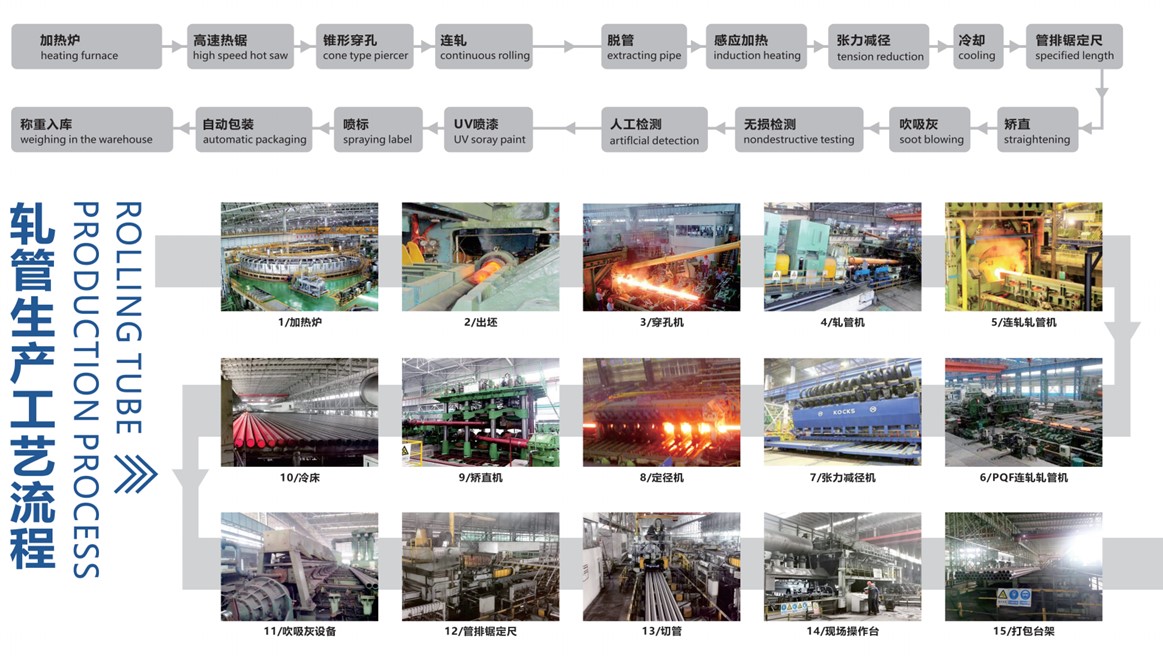
- Heating Furnace: The raw material billets are heated to the appropriate temperature.
- High Speed Hot Saw: The heated billets are cut to specific lengths.
- Cone Type Piercer: This is where the solid billet is pierced to form a hollow shell.
- Continuous Rolling: The hollow shell is then continuously rolled to achieve the desired dimensions.
- Extracting Pipe: The pipe is extracted from the rolling mill.
- Induction Heating: Further heating may be applied for processing.
- Tension Reduction: The pipe undergoes tension reduction to refine its dimensions.
- Cooling: The pipe is cooled down.
- Specified Length: The pipe is cut to the required final length.
- Straightening: The pipe is straightened to ensure uniformity.
- Soot Blowing: Any internal residue is removed.
- Nondestructive Testing: The pipes undergo rigorous testing to ensure quality and detect any flaws.
- Artificial Detection: Additional manual inspections are performed.
- UV Spray Paint: A protective layer of paint is applied.
- Spraying Label: Product information is labeled on the pipe.
- Automatic Packaging: The pipes are automatically packaged.
- Weighing in the Warehouse: The packaged pipes are weighed before storage and delivery.